Health Is Carried by People: Why Relationships Matter in Health and Illness
Published 31-08-2026
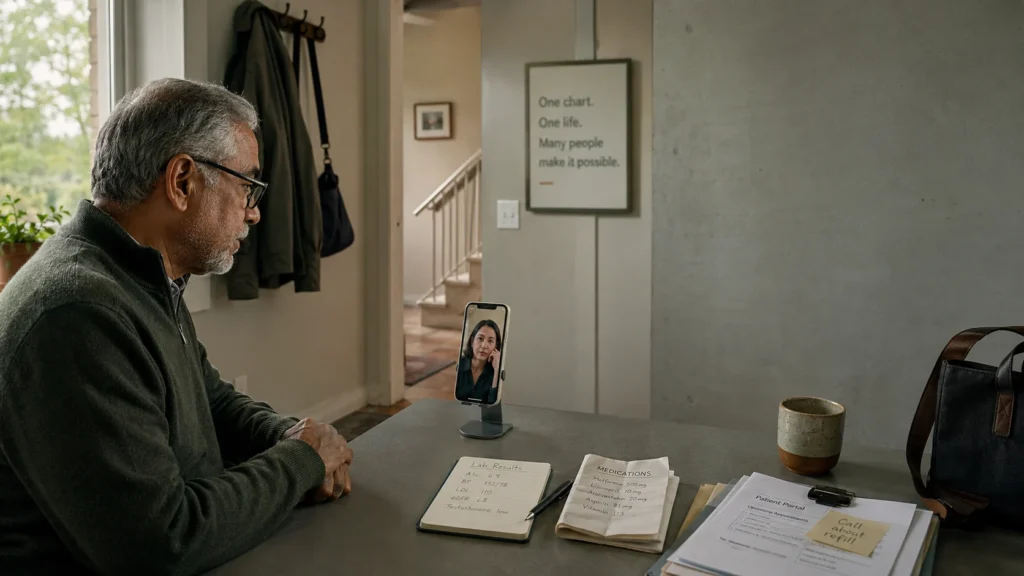
The man across from me has come prepared.
His medication list is folded inside a small notebook. He has brought his latest laboratory results and several weeks of blood-pressure readings. His daughter has come too, although not through the door.
Her face is on his telephone, propped against the edge of my desk.
She is calling from another country.
When I ask when one medication was changed, she remembers. When he tells me he is walking reasonably well, she interrupts gently.
“Tell the doctor about the stairs.”
He smiles.
She knows that he has begun stopping halfway up.
Later, when we discuss another test, she asks how quickly it needs to be arranged. She can make calls. She can remind him. She can listen to the instructions again after he has forgotten part of the conversation.
She cannot drive him there.
Before the consultation ends, I notice how easily I could write family involved in the record and move on.
The phrase would be true.
It would also tell the next clinician very little.
This man is not lonely in any simple sense. He speaks to his daughter every day. He knows his neighbors. He values living independently and manages much of his own health well.
But his relationships have a geography.
They have functions.
And they have limits.
It took me longer than it should have to see those distinctions clinically. Medicine trained me to ask what disease a patient had, what treatment was indicated, and what that patient could reasonably manage.
Years of practice added another question:
How much of what I was calling one person’s capacity was actually being supplied by someone else?
The chart names one patient. Illness reaches farther.
Medicine has good reasons for organizing care around individuals.
A blood pressure belongs to one body. So does a tumor, a blocked artery, an HbA1c result, a creatinine level, a prescription.
The chart needs a name.
Illness is less respectful of that boundary.
A new diagnosis may change what an entire household eats. A stroke changes who drives. Dementia can reorganize another person’s sleep. Cancer treatment can change a spouse’s working hours. Chronic illness may turn an adult child into the person who remembers the history, translates medical language, makes appointments, or notices that a parent no longer sounds quite right on the telephone.
This does not mean that every patient needs a caregiver.
Many people live alone by choice and manage their health with competence. Independence deserves respect, not suspicion.
The point is different.
Health is biologically personal, but much of the capacity around health is relational.
Another person may remember when fear has made concentration difficult. They may notice that the refrigerator is empty. They may ask the question the patient was embarrassed to ask. Sometimes they make treatment possible through something as ordinary as a car ride.
Sometimes no one does.
Once I began noticing that difference, it stopped feeling like social background.
It became part of how I understood the patient in front of me.
What another person quietly makes possible
We speak easily about the importance of social connection.
People need people.
True enough.
But that sentence is too vague for medicine.
The World Health Organization now describes social connection through three dimensions: its structure, its function, and its quality. Structure includes how many relationships we have and how often we interact. Function concerns what those relationships actually provide. Quality asks whether the relationships themselves are supportive, strained, secure, or harmful.¹
That distinction matters at the bedside.
One patient may know dozens of people and have nobody who can accompany him to chemotherapy.
Another may have only two close relationships, both dependable.
A third may receive considerable practical help from a relationship filled with conflict.
Counting contacts tells us surprisingly little.
What people actually change is more concrete.
Someone may collect medication or prepare food. Another person hears the same medical explanation and remembers the part the patient missed. A walking routine lasts longer because someone else is waiting at the door. A family member notices confusion before the patient recognizes it. A friend makes it easier to return to rehabilitation after an embarrassing setback.
Relationships can also influence stress, behavior, sleep, and other physiological pathways. Those effects are real, but they are complicated and bidirectional: illness can reduce social connection just as poor social connection may worsen health.²
In cardiovascular disease, a 2024 systematic review examined eleven studies of social support and self-care among people with coronary heart disease or heart failure. All eleven reported positive associations between social support and self-care behavior.³
But all eleven studies were cross-sectional.
They can show that support and self-care travel together. They cannot tell us with confidence which produced the other, or how much of either relationship is explained by health, income, function, personality, or other factors.
That uncertainty is worth keeping.
I am wary when the science of relationships becomes too tidy.
Friendship is not a drug.
Marriage is not a treatment.
A daughter cannot lower LDL cholesterol through affection.
What another person can change are the conditions in which treatment has to survive.
That is already enough to matter.
“Family available” tells us less than we think
I understand why we use it.
But available for what?
A daughter may answer the telephone every evening and live three hours away.
A husband may be physically present and unable to lift his wife safely.
A son may understand the medications perfectly and work nights.
A partner may want to help but freeze when asked to manage a wound or injection.
Relationships do not come with equal amounts of health, time, money, confidence, mobility, or freedom.
The Sandwich Generation makes this easy to see.
In Caregiving in the U.S. 2025, AARP and the National Alliance for Caregiving classified 29 percent of family caregivers as sandwich-generation caregivers: they were providing care to an adult while also having children or grandchildren younger than eighteen living in their household. Among caregivers younger than fifty, the proportion reached 47 percent.⁴
Six in ten caregivers were also employed.
For many, care therefore enters a life already organized around other people.
The chart may contain one short line:
Daughter involved.
Her own day may contain a school run, a shift she cannot leave early, an appointment she has already postponed twice, and another relative expecting her call.
Caring deeply does not make a person infinitely available.
In families, reliability can quietly become a job description. The person who answers every call becomes the person everyone calls first.
That person may also be running short of support.
A 2025 analysis of nationally representative U.S. data on family and unpaid caregivers of older adults found that about 12 percent were socially isolated and 27 percent reported loneliness.⁵
The person holding someone else’s network together may have a thin network of their own.
This is why I have become cautious about treating the existence of a relationship as proof that a problem has been solved.
There may be affection.
There may be loyalty.
There may be willingness to help.
There may still be very little practical room left.
Caregiving can contain love, duty, satisfaction, exhaustion, irritation, tenderness, and resentment without any one of those feelings cancelling the others.
We do relationships no favor by pretending otherwise.
Knowing that someone is there is not the same as knowing what help is actually available.
Some patients have no one to call
At the other end, sometimes the empty space is real.
A spouse has died.
Children live abroad.
Friends have aged too.
Retirement removed relationships that used to arrive automatically with work. Hearing loss makes conversation tiring. Mobility has narrowed the radius of the week. The bus route disappeared. Moving house broke a neighborhood network that had taken decades to build.
Sometimes there was never much of a network.
Precision matters here.
Living alone is not the same as social isolation. Social isolation is not the same as loneliness.
WHO defines social isolation as an objective shortage of social relationships or interactions. Loneliness is subjective: the painful mismatch between the connection a person has and the connection they want or need.¹
A person can live alone and feel deeply connected.
Someone else can eat every meal beside another human being and feel profoundly alone.
That is why “Do you live alone?” is useful information but an incomplete question.
The health associations are substantial enough without exaggerating them.
A 2023 meta-analysis brought together 90 prospective cohort studies involving more than 2.2 million people. Social isolation was associated with a 32 percent higher relative risk of all-cause mortality, while loneliness was associated with a 14 percent higher relative risk. Social isolation was also associated with higher cardiovascular mortality.⁶
These are observational associations.
They do not prove that isolation itself caused every excess death, nor that adding social contact would reverse the risk.
Poor health can isolate people. So can disability, depression, bereavement, poverty, unsafe neighborhoods, and loss of mobility. Isolation may then make health harder to manage. The directions can reinforce each other until cause and consequence become difficult to separate.
I would rather preserve that complexity than turn loneliness into another dramatic slogan.
For the clinician, there is also a simpler problem.
Who notices change?
Who can be called when a symptom is ambiguous?
Who can collect a prescription?
Who knows what this person normally sounds like?
Who would realize that the phone has gone unanswered?
In a strong network, these functions can occur almost invisibly.
Without one, they do not disappear.
They fall back onto the patient.
The same person who is ill may have to observe the illness, interpret what has changed, remember the plan, arrange the transport, decide when concern is justified, and find the right person to tell.
Independence can be a strength. Having no backup is something else.
And telling someone in that position simply to “connect more” risks becoming another prescription whose feasibility we have not examined.
WHO’s work on social connection makes the wider problem explicit. Health, income, disability, bereavement, transportation, public spaces, and the resources of a community can all shape whether relationships are easy to maintain or difficult to reach.¹
Sometimes the distance between a patient and other people is emotional.
Sometimes it is kilometres, stairs, money, hearing, or a bus that no longer comes.
Trust changes what reaches the clinician
Relationships matter inside medicine too.
Early in my career, I thought the central duty in communication was accuracy.
Explain the disease correctly.
Describe the risk honestly.
Give enough information for a decision.
I still believe all of that.
But accurate information does not guarantee an honest conversation.
A patient who does not trust me may nod while withholding the symptom that frightened him.
Someone may agree to a treatment they have no intention of taking.
A woman may not tell me that the prescription is unaffordable because the conversation has made money feel like an embarrassing failure.
A patient may leave a consultation apparently reassured when what they actually feel is unconvinced.
The medical record can look orderly afterward.
The relationship may not be.
Trust is difficult to study partly because researchers have not always meant the same thing by it. A 2023 review covering more than five decades of health-care trust research identified 725 publications and found persistent disagreement over definitions, dimensions, and measurement.⁷
The outcome evidence is similarly nuanced.
A 2017 meta-analysis of 47 studies involving more than 34,000 participants found a small-to-moderate overall association between trust in health professionals and health outcomes. The association was stronger for patient-reported outcomes and health behaviors. Associations with objective health outcomes were not statistically significant, and the authors cautioned that the overall estimate could be biased upward.⁸
That is not evidence that trust cures disease.
It is enough to take trust seriously.
I have come to think of its clinical value in another way.
Trust changes what information becomes speakable.
It affects whether uncertainty is admitted.
Whether disagreement surfaces while there is still time to discuss it.
Whether “I understand” means I understand rather than I would like this conversation to end.
Whether a patient tells us that the treatment we have prescribed simply will not happen.
Medicine needs those truths.
An answer we never hear cannot influence a decision.
Information can cross a room without trust.
Care has a harder time doing so.
Relationships can support care. They cannot replace a care system.
Recognizing the importance of relationships creates its own danger.
We may begin expecting relationships to solve problems simply because relationships are valuable.
The intervention literature should make us humble.
A 2023 Cochrane review examined 54 randomized trials involving 11,445 people with heart disease. Programs designed to increase social-network or social-support input showed no clear effect on mortality. There was little or no clear difference in hospital admissions, and evidence for quality-of-life effects remained very uncertain.⁹
The certainty of much of that evidence was low or very low.
This does not make relationships irrelevant.
It tells us that real human connection is not easily packaged into a standardized intervention with a predictable medical effect.
A friend of thirty years is not interchangeable with a scheduled telephone call.
A trusted neighbor is not a twelve-week program.
And neither should be expected to compensate indefinitely for inaccessible healthcare, unaffordable treatment, inadequate home support, or a plan that assumes resources a household does not possess.
This matters most when private support is thin.
A safe care system should not work only for patients who happen to arrive with a strong private network.
Nor should the presence of a capable family quietly reduce how much formal support we think a patient deserves.
This is where the People path meets Medicine’s Blind Spot.
Medicine can identify the patient with remarkable precision.
The harder task is seeing the relational conditions around that patient without turning them either into sentiment or into an invisible extension of the care system.
A cardiologist cannot replace a dead spouse.
A surgeon cannot create trustworthy friends.
A clinic cannot repair every estranged family or redesign a neighborhood during an appointment.
But recognizing that support is absent, distant, fragile, or overloaded can change what we assume a patient can realistically carry.
The point is not to medicalize friendship.
It is to stop designing care as though friendship, family, transport, advocacy, memory, and practical help will simply appear when needed.
The circles around one patient
Over time, I began to picture health in three circles.
The inner circle is the person: physiology, symptoms, choices, beliefs, capacity, sleep, movement, food, medication.
Around that sits a middle circle: family, friends, caregivers, clinicians, neighbors, colleagues, community.
Around both is an outer circle: healthcare systems, transportation, housing, affordability, public spaces, policy, technology, and the other conditions that make participation easier or harder.
I call these the Circles of Longevity.
I did not need the image when the problem still looked like an individual one.
I needed it after too many patients made the same lesson difficult to ignore.
No circle works alone.
Personal responsibility matters.
Relationships matter.
Systems matter.
But none should become an excuse for neglecting the others.
When the middle circle is strong, it can add remarkable capacity. Someone notices. Remembers. Accompanies. Encourages. Challenges. Shows up.
When that circle is overloaded, support may still look intact from the outside while becoming harder to sustain.
When it is thin, the person at the center has to perform more functions alone.
And when the outer circle is weak, families and friends may spend their own reserves compensating for barriers they did not create.
I think again of the man in my clinic and his daughter on the telephone.
She was unquestionably part of his health.
So was the distance between them.
So was his wish to remain independent.
So was the neighbor who might drive him.
And so was the clinic that would have to decide what happened if none of those arrangements proved enough.
The important question is not whether a patient’s social world looks rich or poor from the outside.
Medicine is not there to grade relationships.
What matters is whether the care we are planning quietly assumes that certain human functions will be available.
Who knows this person well enough to notice change?
Who can actually help?
Who cannot?
Who is already carrying something else?
And if the answer is no one, what does that change?
Those are not soft questions sitting politely beside medicine.
They can determine whether medicine remains usable after the consultation ends.
The chart will still need one patient’s name.
Good care sometimes needs a wider field of view.
Medicine treats one body at a time. Care has to see the people around it, and the empty chairs too.
References
- World Health Organization. From Loneliness to Social Connection—Charting a Path to Healthier Societies: Report of the WHO Commission on Social Connection. Geneva: World Health Organization; 2025.
- Holt-Lunstad J. Why social relationships are important for physical health: a systems approach to understanding and modifying risk and protection. Annual Review of Psychology. 2018;69:437–458. doi:10.1146/annurev-psych-122216-011902.
- Babygeetha A, Devineni D. Social support and adherence to self-care behavior among patients with coronary heart disease and heart failure: a systematic review. Europe’s Journal of Psychology. 2024;20(1):63–77. doi:10.5964/ejop.12131.
- AARP and National Alliance for Caregiving. Caregiving in the U.S. 2025. Washington, DC: AARP; 2025. doi:10.26419/ppi.00373.001.
- Qian Y, Pomeroy ML, Petchler CM, Saylor MA, Cudjoe TKM, Ornstein KA. The epidemiology of social isolation and loneliness among family and unpaid caregivers of older adults: findings from the National Study of Caregiving. The Journals of Gerontology: Series B. 2025;80(7):gbaf101. doi:10.1093/geronb/gbaf101.
- Wang F, Gao Y, Han Z, et al. A systematic review and meta-analysis of 90 cohort studies of social isolation, loneliness and mortality. Nature Human Behaviour. 2023;7:1307–1319. doi:10.1038/s41562-023-01617-6.
- Taylor LA, Nong P, Platt J. Fifty years of trust research in health care: a synthetic review. The Milbank Quarterly. 2023;101(1):126–178. doi:10.1111/1468-0009.12598.
- Birkhäuer J, Gaab J, Kossowsky J, et al. Trust in the health care professional and health outcome: a meta-analysis. PLoS ONE. 2017;12(2):e0170988. doi:10.1371/journal.pone.0170988.
- Purcell C, Dibben G, Hilton Boon M, et al. Social network interventions to support cardiac rehabilitation and secondary prevention in the management of people with heart disease. Cochrane Database of Systematic Reviews. 2023;(6):CD013820. doi:10.1002/14651858.CD013820.pub2.
Author’s note: The opening scene is a composite drawn from recurring clinical situations. It does not represent a single identifiable patient.
About the author
Mustafa Kemal Calik, MD, is a cardiovascular surgeon and digital health consultant. He writes about the space between medical capability and ordinary life; how care, technology, relationships, and daily conditions shape what happens after the clinical decision is made.