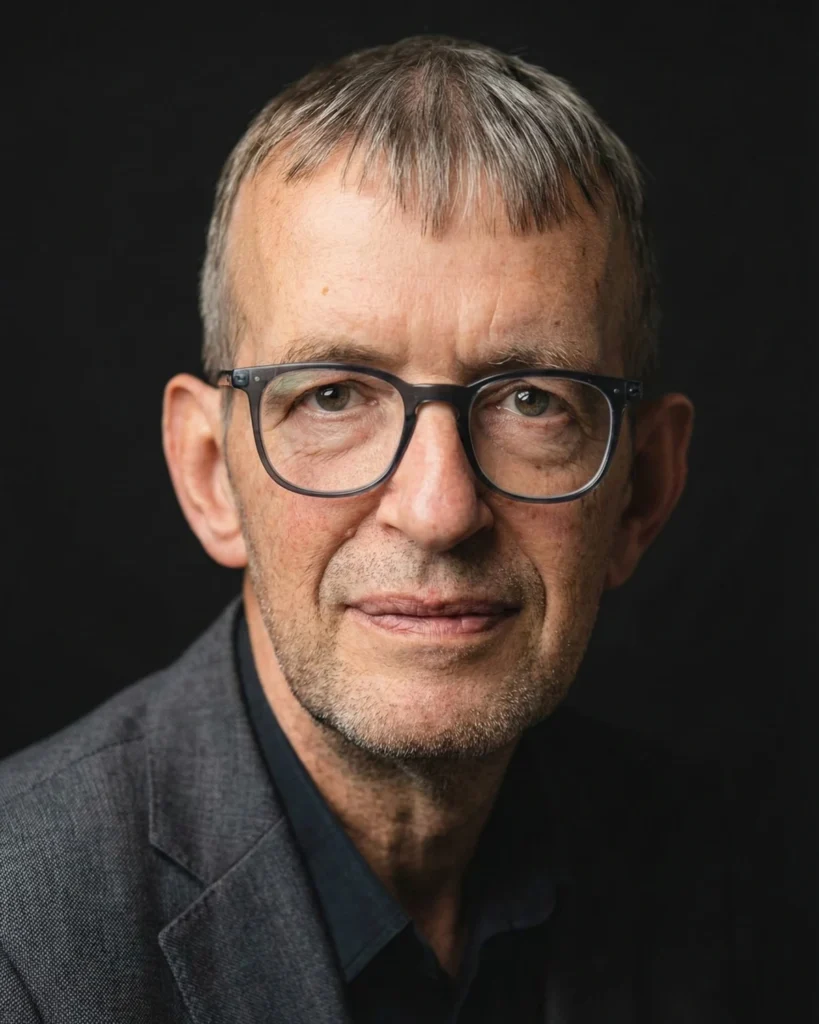
About Mustafa Kemal Çalık, MD
Cardiovascular Surgeon. Patient. A life spent looking at what happens after medicine has done its part.
I have spent more than three decades in cardiovascular medicine, much of it in operating rooms where decisions are measured in minutes and millimeters.
Medicine taught me what a successful intervention can accomplish. It can restore blood flow, repair an artery, relieve suffering, and sometimes give a person back a future that seemed to be disappearing.
But another part of my education happened outside the operating room.
It happened in a hospital bed.
It happened in a refugee clinic.
And, over the years, it happened in the homes and ordinary lives my patients returned to after we had done everything medicine considered successful.
Those experiences eventually led me to a question that now sits at the center of my work:
What happens when medical success meets ordinary life?
That is where StayOnHealth begins.
I learned medicine from both ends of the scalpel
I became a patient before I had finished becoming a doctor.
As a medical student, I discovered a parotid tumor behind my ear. Five years later, after the tumor recurred deep near the skull base, I underwent a seven-and-a-half-hour operation.
The operation succeeded.
I woke with half my face paralyzed.
Recovery took two years.
That distinction stayed with me: an intervention can finish in hours while its consequences continue through hundreds of ordinary mornings.
There were exercises no surgeon supervised. Meals had to be relearned. Confidence returned more slowly than function. I began to understand something that medical training had not prepared me to see clearly.
Survival and healing are not the same achievement.
Years later, after performing thousands of cardiovascular and vascular procedures myself, I began recognizing versions of that same gap in my patients.
We could restore circulation. Stabilize the numbers. Complete the procedure.
Then the patient went home.
And another kind of medicine began.
The places medicine cannot control
Early in my career, during the 1988 Kurdish refugee influx into Türkiye, I worked in resource-limited conditions caring for displaced families arriving from northern Iraq, including emergency work coordinated with UNHCR.
There, much of what a hospital normally guarantees could no longer be assumed.
Privacy. Equipment. Transportation. Follow-up. Even time.
It was an uncompromising lesson in what remains when infrastructure falls away.
Clinical expertise still mattered enormously. But so did trust, improvisation, communication, family, and the ability to make a workable decision with whatever was actually available.
Decades later, I would recognize the same principle in a less dramatic setting.
A medical plan can be scientifically correct and still fail if the person expected to carry it cannot make it work in ordinary life.
Medicine’s Blind Spot
Modern medicine has become extraordinarily good at rescue.
That is one of its great achievements.
We survive heart attacks, operations, cancers, strokes, and chronic diseases that would once have shortened lives far earlier.
But success has created a quieter challenge.
More of the work of living with illness now happens outside hospitals—inside kitchens, bedrooms, workplaces, family conversations, medication boxes, phone calls, apps, sleepless nights, and decisions made when no clinician is in the room.
Responsibility has moved outward faster than preparation has followed it.
I call this Medicine’s Blind Spot.
It is not an argument against modern medicine. Quite the opposite. It becomes visible partly because medicine has become so successful.
We have learned to rescue people from disease faster than society has learned to live with it.
StayOnHealth explores that unfinished territory.
From surgery to digital health
My clinical work eventually led me toward another question: can technology make the space between medical visits safer and easier to navigate?
Since 2015, my work has increasingly included digital health, patient engagement, remote care, self-management, and healthcare innovation.
I have helped develop digital approaches intended to make everyday health management simpler, and I have advised healthcare leaders on cardiovascular medicine, patient management, and digital-health implementation.
That work made me both more interested in technology and more skeptical of technological enthusiasm.
A device can detect something important.
An algorithm can organize information.
An application can reduce friction.
But information does not become care merely because it reaches a screen.
Someone still has to understand what matters, decide what happens next, and live with the consequences.
Technology should reduce the work of being a patient or caregiver.
It should not quietly add to it.
Why I created StayOnHealth
StayOnHealth is not a wellness site built around optimization, miracle routines, or promises of perfect health.
Nor is it a digital clinic.
It is an independent editorial publication about the space where medicine meets life.
I write about the questions that have followed me through years of surgery, recovery, digital health, and observation:
What makes medical advice usable after the appointment ends?
Why do some technically successful treatments become fragile at home?
What happens when families become part of the care system without ever being trained for the role?
When does more health data help us—and when does it simply create more anxiety?
How do sleep, food, movement, relationships, neighborhoods, technology, money, time, and access become part of health long before they appear in a medical record?
And perhaps most important:
What can medicine finish, and what must the rest of us learn to carry?
These questions also form the intellectual foundation of my book, Two Ends of the Scalpel, a work of narrative nonfiction about medical success, recovery, caregiving, technology, continuity, and the life that continues after the intervention is over.
A wider view of health
Over the years, I have become less interested in telling people to “take responsibility for their health” without asking what responsibility actually requires.
A person makes choices.
But no person makes them alone.
Health is shaped by families, caregivers, income, time, neighborhoods, transportation, digital access, healthcare systems, and whether someone is present when things begin to go wrong.
This is why StayOnHealth moves between physiology and ordinary life.
The artery matters.
So does the kitchen table.
The medication matters.
So does whether someone can afford it, understand it, remember it, and know whom to call when something changes.
The technology matters.
So does the person expected to use it.
I believe medicine becomes more useful—not less scientific—when we widen the frame.
Professional background
I am a cardiovascular surgeon with more than thirty years of clinical experience across cardiovascular and vascular medicine.
My work has included cardiac, carotid, and aortic surgery, critical limb ischemia, vascular ulcers, and minimally invasive treatment of venous disease. I founded and directed a specialized vascular clinic and later expanded my work into digital health, patient engagement, continuity of care, and healthcare innovation.
My digital-health work has received international recognition, including three Stevie Awards in the International Business Awards and recognition from the Interactive Media Council.
I have also contributed to work concerning community-based healthy aging and have advised healthcare leaders through international expert networks.
I live and write from Türkiye for an international readership.
The systems may differ from country to country.
The human problem often does not.
What I hope StayOnHealth becomes
I do not want StayOnHealth to give readers more health information simply because more information can be produced.
There is already more than enough of that.
I want it to help us see more clearly.
To distinguish a useful signal from noise.
To understand the trade-offs hidden inside apparently simple medical decisions.
To recognize where individual effort matters—and where families, communities, technology, and systems must carry their share.
And to keep asking what happens after the consultation, after the procedure, after the discharge papers, when medicine is no longer standing beside us.
That is often where the real work begins.
Medicine can perform the intervention. Life has to carry the result.
Mustafa Kemal Çalık, MD
Cardiovascular Surgeon
Digital Health Consultant