After Hospital Discharge: Why Follow-Through Is Part of the Treatment
Published 01-09-2026
The patient has no incision.
Nothing has been bypassed, replaced, removed, or stitched. He came to the hospital short of breath, his ankles swollen, unable to sleep comfortably unless he propped himself upright. A few days later, after tests, diuretics, oxygen, medication changes, and conversations with several clinicians, he is preparing to leave with something he did not have when he arrived: a diagnosis of heart failure.
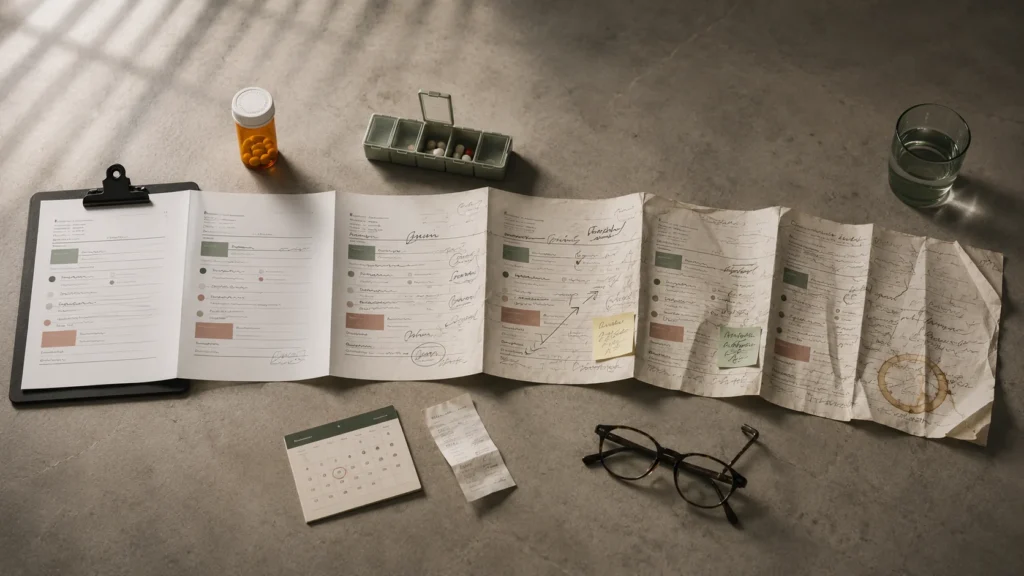
The bed beside him is covered with papers.
One sheet lists medications. Another explains follow-up. There are instructions about weight, salt, fluid, activity, symptoms, and when to seek help. His wife holds an older medication list and is trying to work out which tablets have disappeared. He wants to know whether climbing the stairs to his bedroom is safe.
Both are listening.
Neither looks careless.
They look full.
I have seen versions of this scene after operations, heart attacks, strokes, infections, and new diagnoses. The clinical details change. The transition does not.
Inside the hospital, care is held together almost without the patient having to think about how. The right tablets arrive. Blood pressure is checked. A nurse notices that breakfast has barely been touched. An abnormal result enters a clinical conversation. If breathing changes, someone is nearby to see it.
Then the patient goes home.
The illness goes too.
So does the treatment.
What does not travel automatically is the system that had been holding them together.
The hospital can name a discharge date. The body cannot.
Hospitals need boundaries. A person is admitted, transferred, discharged. These moments matter medically, administratively, and legally.
The body is less interested in our paperwork.
A sternotomy is not healed because the discharge summary has been signed. Pneumonia may be improving while strength remains poor. Someone newly diagnosed with diabetes does not leave the ward already knowing how diabetes will fit into meals, work, travel, illness, sleep, or fear.
A patient with heart failure may be stable enough to leave while still learning an entirely new vocabulary for his own body. Yesterday, an ankle was simply an ankle. Now swelling may mean something. A bathroom scale has acquired clinical importance. Breathlessness has become a judgment: expected, concerning, or dangerous?
For some patients, discharge marks recovery from an acute event.
For others, particularly those newly diagnosed with chronic disease, it marks the beginning of living knowingly with a condition that may require attention for years.
That is a different kind of transition.
Current policy increasingly treats discharge planning as more than a final-day administrative task. CMS guidance says planning should begin early for patients at risk of adverse consequences and should support a safe transition while incorporating patients’ goals, preferences, needs, and, where appropriate, caregivers.¹ AHRQ’s IDEAL discharge approach likewise emphasizes involving patients and families, explaining the condition and next steps in plain language, reviewing medications and warning signs, and arranging follow-up.²
All of that is necessary.
But the harder test begins when the hospital is no longer the place keeping the pieces together.
Can the plan still work then?
That is the question behind Follow-Through.
Follow-through is not another word for compliance
Medical language can make the direction of responsibility sound deceptively clear.
The patient adheres or does not.
Takes the medication or misses it.
Keeps the appointment or fails to attend.
Follows the recommendation or does not comply.
Those descriptions sometimes tell us exactly what happened.
They do not always tell us why.
Over the years, I have become uneasy with how easily the last event in a sequence can become the explanation for everything before it.
Before deciding that a patient failed to follow a plan, I want to know what happened to the plan on its way there.
Did the patient understand which medicine had stopped and which had only changed dose? Could the prescription be obtained? Did someone explain why the early appointment mattered? Was there a way to reach it? Did the patient know which symptom could wait until morning and which should not?
And if the illness changed, was there somewhere for the plan to change with it?
That last question becomes especially important in chronic disease.
The first discharge plan for heart failure, COPD, kidney disease, cancer, or diabetes cannot anticipate every month that follows. Another illness appears. Kidney function changes. Arthritis limits walking. A new specialist adds treatment. The spouse who organized the medicines becomes ill. What once fitted no longer does.
Follow-through cannot mean following an old plan more faithfully after the circumstances that justified it have changed.
Follow-through is the shared work that keeps a medical plan understandable, usable, connected, and responsive after the patient leaves the setting in which that plan was created.
Patients have responsibilities within that process.
So do clinicians and health systems.
Families may be part of it too, when they are willing and able.
The point is not to move responsibility away from the patient. It is to stop pretending that one person’s determination can substitute for a functioning chain of care.
A plan can be complete on paper and still become unusable
There is a difference between information being present and information being usable.
The discharge packet may be impeccable.
The medication list is there. The appointments are there. So are the instructions about diet, rehabilitation, wound care, activity, monitoring, and warning signs.
Nothing is technically missing.
But the person receiving all of this may be tired, frightened, weak, in pain, sleeping badly, and still trying to understand what has happened to his body.
The literature has begun to describe this transition in appropriately practical terms.
In 2026, Hardeep Singh and colleagues examined the work performed by patients and caregivers during hospital-to-home transitions: not merely the health-related tasks they undertake, but the physical and cognitive effort required to complete them. Their qualitative study found that informational, management, and relational continuity shaped how manageable that work became.³
The study was small, ten participants with complex care needs in Ontario, and should not be made to carry more than it can.
But its language is useful.
Because much of what happens after discharge is not one difficult task.
It is translation.
What did they mean?
Which tablet is this?
Who deals with that result?
Is this symptom expected?
Does the advice still apply today?
Medications make the problem unusually visible.
Hospitalization often changes them. A drug is stopped. Another is added. A dose moves up or down. The new list travels home to a cupboard that may still contain the old one.
In a 2025 Norwegian study of 150 people with multiple long-term conditions who were taking at least four medicines, 132—88 percent—had at least one discrepancy between the hospital discharge medication list and what they were actually taking one to two weeks later. The median was three discrepancies per patient.⁴
This was a specific, medically complex population. It is not a universal post-discharge rate.
Still, 132 people standing between one list and another should make us pay attention.
A plan can be completely documented and incompletely transferred.
And a transfer that looked successful on Tuesday can become confusing by Thursday.
A plan can be complete on paper and still become unusable by Thursday.
The first breaks are usually small
The failures that concern me most are not always dramatic.
At least not at first.
The family arrives home after the pharmacy has closed.
An old tablet remains in the pill organizer.
A specialist changes a medicine but another clinician sees the new dose without the reason behind it.
A follow-up appointment is booked. No one has asked how the patient will get there.
A person newly diagnosed with diabetes understands that glucose must be checked but has only a vague idea what a particular result should change.
Someone with COPD becomes a little more breathless each day but waits because the instructions said to call if symptoms “worsen,” and worsen seems too serious a word for what is happening.
Each of these moments can look harmless in isolation.
That is part of the danger.
A 2025 systematic review and qualitative meta-synthesis examined 98 studies of hospital-to-home transitions and included 53 after quality appraisal. Across patients, families, and healthcare professionals, four themes kept returning: care coordination and continuity, communication, patient and family involvement, and individualized support and information exchange.⁵
There is nothing glamorous on that list.
No breakthrough drug.
No sophisticated device.
No heroic rescue.
But this is often what keeps good medicine from slowly coming apart after it leaves the hospital.
Earlier in my career, I thought of follow-up mainly as the next appointment.
I no longer do.
An appointment is a point on a calendar.
Follow-through is what preserves enough understanding until the patient reaches it—and what makes it possible to act earlier if waiting for that date no longer makes sense.
Facts can travel while meaning gets lost
We are much better at moving medical information than we once were.
Discharge summaries can arrive electronically. Laboratory results appear in portals. Medication records can follow patients across parts of a health system. Imaging can be viewed without carrying a film from one building to another.
These advances matter.
But facts survive transfer more easily than context does.
A record may say that furosemide was increased.
Why?
It may document a rise in creatinine.
Did that alter the plan?
It may contain a cardiology appointment six days from now.
What question is that appointment supposed to answer?
It may say “family support available.”
Available for what?
The distinction becomes sharper in people living with several chronic diseases. Their care does not follow one clean pathway. Heart failure meets kidney function. Diabetes meets appetite. Arthritis changes mobility. COPD changes what an exercise prescription means. Depression changes attention, sleep, and the energy required to manage everything else.
No discharge document can settle all of that permanently.
I do not think it should try.
What matters is preserving enough clinical thread that the next person does not have to reconstruct the whole story from disconnected facts—and the patient does not have to become the sole historian of why medicine changed its mind.
Surgery taught me to respect handoffs because a lost detail in the operating room can become dangerous quickly.
Outside the operating room, the danger may unfold more slowly.
That does not make the handoff less clinical.
It makes it easier to underestimate.
A patient can stay home and still have had a poor transition
Readmission matters.
A return to hospital may signal progression of disease, a complication, medication harm, inadequate support, or a failure somewhere in the transition. Preventing avoidable readmissions protects patients and reduces unnecessary healthcare use.
But readmission is an outcome, not a complete definition of what happened after discharge.
A 2022 Cochrane review of 33 trials involving 12,242 participants found that individualized discharge planning probably produces a small reduction in hospital length of stay and probably slightly reduces readmissions among older people admitted with medical conditions. The evidence for effects on broader health status was limited, while patient satisfaction may improve.⁶
A larger 2023 systematic review and network meta-analysis examined 126 randomized trials involving 97,408 participants. Low- and medium-complexity transitional-care interventions were associated with reductions in several measures of healthcare use. But relatively few trials examined patient-reported outcomes, and the authors called for broader outcome sets capable of capturing the full impact of transitional care.⁷
That limitation interests me.
Because a patient can avoid readmission and still have had a poor transition.
He may spend a week frightened because nobody explained whether his breathlessness is expected.
She may take the wrong dose and experience days of dizziness without ever reaching an emergency department.
Rehabilitation may quietly disappear.
Mobility may decline.
An appointment may be missed.
A daughter may spend hours trying to discover which clinic is responsible for a new problem.
A patient may ultimately reach the right medical outcome because someone at home supplied extraordinary amounts of unpaid organization, memory, and persistence.
None of those necessarily creates a readmission.
All of them tell us something about the quality of what happened after discharge.
The reverse deserves equal care.
Not every readmission proves that discharge failed.
Some diseases worsen despite excellent planning. Complications occur despite careful follow-up. Chronic illnesses fluctuate. A patient can understand the plan, take the medication correctly, reach the right clinicians, and still need hospital care again.
Judging every readmission as a preventable transition failure would be as misleading as judging every non-readmission a success.
A poor transition does not always cause readmission.
And a readmission does not always prove a poor transition.
Healthcare often evaluates discharge by looking backward: Did the patient come back? The patient experiences it looking forward: Does tomorrow make sense?
We need both questions.
What has to remain when the hospital is no longer there?
For years, I pictured discharge as a handoff.
The metaphor is useful, but incomplete.
A handoff happens once.
Recovery does not.
Chronic disease certainly does not.
I now think more often in terms of a bridge. Not because patients need another framework to memorize, but because a bridge has to keep carrying weight after the moment it was built.
That is the purpose of Bridges of Care.
Four things repeatedly determine whether the crossing remains possible: People, Plan, Tools, and Checkpoints.
People carry pieces of information that no discharge summary can fully hold. The patient knows the body from the inside. A spouse may notice appetite. A daughter may know what tablets are actually in the house. A pharmacist may find a discrepancy. A primary-care physician may understand the history running beneath several specialist decisions.
A name in the chart, however, should not be mistaken for unlimited help. The care network has limits of its own.
The Plan is not the stack of paper.
It is what remains understandable after the paper is folded, taken home, and opened again when someone is uncertain.
What changed?
What matters most now?
What is temporary?
What would make us reconsider?
For chronic disease, that last question is essential. A durable plan is not one that never changes. It is one that makes change possible without losing the reason behind it.
Tools should reduce friction.
Sometimes the right tool is a portal, blood-pressure cuff, glucose monitor, pill organizer, shared medication list, or remote-monitoring system.
Sometimes it is paper on the refrigerator.
The sophistication of the tool matters less than whether it makes the next judgment easier.
And then there are Checkpoints.
A checkpoint asks whether the person and the plan still fit each other.
Is the swelling improving? Has walking become easier? Did kidney function change? Is the new medication causing dizziness? Is appetite returning? Has the patient become more confused? Is the family still managing what looked manageable three days ago?
Without checkpoints, we can preserve a plan faithfully while the patient changes around it.
That is not continuity.
It is inertia.
The purpose of Follow-Through is not to turn a home into a smaller hospital.
It is to keep care from becoming unrecognizable once continuous clinical observation ends.
The patient goes home. The treatment does not.
I think again of the man leaving with heart failure.
There is no dramatic postoperative wound to inspect. No sternotomy to remind him every morning that something serious happened.
Instead, familiar parts of life have acquired new meanings.
Salt matters differently.
A scale beside the bathroom door matters differently.
A swollen ankle matters differently.
So does a night spent sitting upright because lying flat has become uncomfortable.
The work ahead is not simply remembering instructions. It is learning which ordinary details now carry medical information—and learning where that information should go.
This is true after an operation too. The wound changes. Walking changes. Pain changes. Appetite changes. Recovery is not a straight line, and the instructions that were sensible on discharge day may need interpretation a week later.
Medicine cannot stand beside every patient as those days unfold.
That is neither possible nor desirable.
The clinical task is narrower, and perhaps harder: to leave enough continuity behind that uncertainty has somewhere to go.
A person should know what changed.
Someone should know why it changed.
There should be a route back when the expected course begins to drift.
And there should be permission to revise a plan rather than mistake persistence for good care.
This is one expression of Medicine’s Blind Spot: the wider gap between what medicine can accomplish and what has to remain workable after that accomplishment enters a life.
Hospital medicine is at its most visible when the team is present.
Follow-through begins when that visibility fades.
Discharge ends continuous observation. It should not end the patient’s ability to know what comes next.
References
- Centers for Medicare & Medicaid Services. Revisions to Hospital—Appendix A of the State Operations Manual. QSO-25-24-Hospitals. September 5, 2025.
- Agency for Healthcare Research and Quality. Strategy 4: Care Transitions From Hospital to Home—IDEAL Discharge Planning. Guide to Patient and Family Engagement in Hospital Quality and Safety. Rockville, MD: AHRQ. Originally created 2013; last reviewed 2017.
- Singh H, Nelson MLA, Tang T, et al. Exploring patient and caregiver work and continuity of care during hospital-to-home transitions of care in the Canadian context. Health Expectations. 2026;29(3):e70727. doi:10.1111/hex.70727.
- Syversen MO, Glatkauskas M, Sedeniussen SJ, et al. Discrepancies in medication lists after hospital discharge in patients with multiple long-term conditions. Research in Social and Administrative Pharmacy. 2025;21(8):580–588. doi:10.1016/j.sapharm.2025.03.062.
- van Grootel JWM, Collet RJ, van Dongen JM, et al. Experiences with hospital-to-home transitions: perspectives from patients, family members and healthcare professionals. A systematic review and meta-synthesis of qualitative studies. Disability and Rehabilitation. 2025;47(7):1644–1658. doi:10.1080/09638288.2024.2384624.
- Gonçalves-Bradley DC, Lannin NA, Clemson L, Cameron ID, Shepperd S. Discharge planning from hospital. Cochrane Database of Systematic Reviews. 2022;(2):CD000313. doi:10.1002/14651858.CD000313.pub6.
- Tyler N, Hodkinson A, Planner C, et al. Transitional care interventions from hospital to community to reduce health care use and improve patient outcomes: a systematic review and network meta-analysis. JAMA Network Open. 2023;6(11):e2344825. doi:10.1001/jamanetworkopen.2023.44825.
Author’s note: The opening scene is a composite drawn from recurring clinical situations. It does not represent a single identifiable patient.
About the author
Mustafa Kemal Calik, MD, is a cardiovascular surgeon and digital health consultant. He writes about the space between medical capability and ordinary life; how care, technology, relationships, and daily conditions shape what happens after the clinical decision is made.