The First Night Home Is Not a Medical Setting

The hospital decides when a patient no longer needs a bed. The first night home after hospital discharge reveals whether the life waiting outside can carry what comes next.
By late afternoon, the patient has done everything the hospital asked of him.
He has walked the corridor, eaten enough to reassure the team, passed urine, and learned how to support his chest with a folded pillow when he coughs. His blood pressure is stable. The wound is dry. The medication list has been printed.
His wife sits beside the bed with his clothes folded across her lap. She listens as the nurse reviews the instructions. She nods at the right places and places every sheet of paper inside a plastic folder.
The patient changes slowly. His shoes feel tighter than they did before the operation. The corridor to the elevator seems longer in ordinary clothes.
Still, leaving feels like progress.
The wheelchair reaches the hospital entrance. A relative brings the car around. Bags are placed in the trunk. Doors close. The building recedes behind them.
From the hospital’s point of view, the transition is complete.
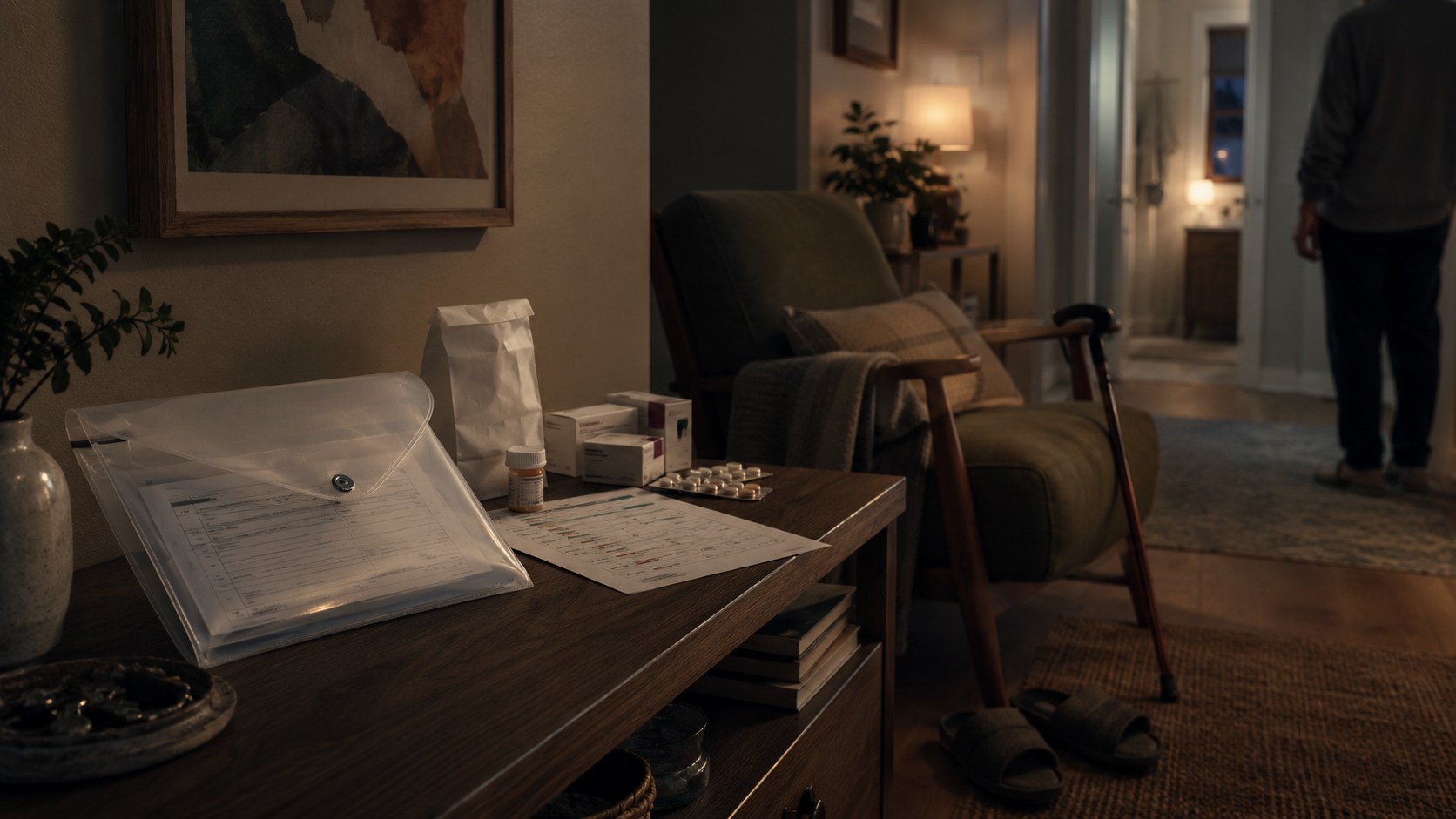
Several hours later, the same patient stands at the entrance to his home and discovers that the front step is higher than he remembers. The chair in the sitting room is too low. The bathroom feels farther from the bed. He is hungry but has no appetite. His wife is trying to reconcile the tablets in the discharge bag with the medicines already in the kitchen cupboard.
Before midnight, he asks whether the pain is normal.
She does not know.
Nothing dramatic has happened. No emergency has declared itself. The operation remains successful, and the discharge decision may have been entirely correct.
But the medical setting has disappeared.
What hospital discharge actually certifies
Discharge is a clinical judgment.
It means that the patient no longer requires the intensity of care provided by the hospital. Vital signs are sufficiently stable. Immediate risks have been assessed. Essential treatment can continue elsewhere.1,4
That is an important achievement. Hospitals carry their own risks, including infection, disrupted sleep, immobility, confusion, and loss of independence. Keeping someone admitted without clinical need is not kindness.
Yet discharge certifies something narrower than families often imagine.
It answers the question:
Can this person leave the hospital?
The household must answer another:
Can we receive everything that is leaving with him?
The patient does not return home alone. He brings pain, weakness, new medicines, altered sleep, reduced appetite, uncertainty, and instructions written for conditions that may change by the hour.
He may look almost like the person who left home a week earlier.
He is not.
Across more than three decades in cardiovascular surgery, I watched this misunderstanding repeat itself. We assessed whether the heart, lungs, wound, circulation, and kidneys were ready.
Families were assessing something less measurable: whether the person they loved could cross the doorway, reach the bathroom, tolerate the night, and wake safely in the morning.
Both assessments mattered.
Only one reliably entered the chart.
The workforce that disappears at the door
Inside a hospital, care appears to be delivered through visible interventions: the operation, the infusion, the scan, the medication.
Much of its safety, however, comes from something quieter.
Someone notices.
A nurse sees that the patient looks different. An aide helps him stand. A pharmacist checks whether two medicines conflict. Food arrives without anyone having to shop for it. Clean sheets appear. Oxygen, suction, equipment, and another pair of hands are nearby. If uncertainty rises, responsibility can move upward through a clinical hierarchy.
The patient may not see this structure, but he is resting inside it.
At home, much of that structure may fall away.
What remains may be one tired person who has never changed a dressing, interpreted breathlessness, or decided whether pain can wait until morning.
She becomes the medication coordinator, mobility assistant, cook, observer, and night watch. She may also be a spouse who is frightened, an adult daughter answering work messages, or an older caregiver with illnesses of her own.
She receives no shift handover.
Only a folder.
For years, I believed that a careful explanation could solve much of this. I explained the medicines, warning signs, activity limits, and follow-up plan. The information was correct. Often it was clear.
It was not always usable.
Families do not always struggle because no one has told them anything. Often, too much has been said at a moment when fear, fatigue, and relief have narrowed what they can absorb.
The patient is thinking about leaving.
The family is thinking about keeping him alive.
The clinician is thinking about completing a safe discharge.
Everyone is present. They are not standing in the same future.
“She receives no shift handover. Only a folder.”
A correct plan can arrive too large
Medical plans are written as a series of tasks.
Take these medicines. Walk several times. Eat regularly. Monitor the wound. Record the blood pressure. Attend the follow-up appointment. Call if certain symptoms appear.
Each instruction may be reasonable.
Together, they can exceed the capacity of the household receiving them.
Capacity is not motivation. It is what remains available after illness has taken its share.
A patient may understand that walking matters but be unable to rise from a low chair without help. He may know he should eat but feel nauseated by the smell of food. He may be able to read every instruction and still become confused when the new medication list does not resemble the boxes already at home.
The family’s capacity is also finite.
Love does not create clinical training. Concern does not prevent exhaustion. A daughter can be devoted and still need to return to work. A spouse can listen carefully and still misunderstand a dose at midnight. A family can agree with every recommendation and lack the money, transport, space, or time required to carry it out.
This is where Medicine’s Blind Spot becomes visible.
The plan may be medically sound. The life around it may not yet be able to hold it.
That does not mean the family has failed.
It means the plan has changed environments.
In the hospital, a recommendation enters a system designed to support it. At home, it enters a kitchen, a staircase, a work schedule, an old marriage, a crowded apartment, or a household where everyone is already carrying something.
The same discharge plan is not the same burden in every home.2,3
“The plan may be medically sound. The life around it may not yet be able to hold it.”
What the first night home after hospital discharge reveals
The first night home is rarely dramatic enough to appear in medical history.
Often it consists of small negotiations.
Which side of the bed will make standing easier? Can the patient sleep flat? Should the bathroom light remain on? Was the evening tablet already given at the hospital? Is the wound supposed to look like that? Is the patient unusually quiet because he is tired, frightened, or becoming unwell?
In the hospital, a family can press a button.
At home, they must decide whether the question justifies disturbing someone, waiting until morning, searching online, or going back to the emergency department they were relieved to leave.
This is why the first night is not simply the beginning of recovery. It is a test of fit between a medical plan and an ordinary life.
Some households are well prepared. There is a bedroom on the ground floor, a relative who understands the medications, a nearby pharmacy, reliable transport, and a number that will be answered if something changes.
Others begin from a different place.
The patient lives alone. The building has no lift. Instructions were given in a language the caregiver only partly understands. The person expected to stay overnight works a night shift. The prescription cannot be filled until morning. The only bathroom requires a difficult walk. The family is already caring for someone else.
These are not background details.
On the first night, they become clinical conditions.
Discharge planning can treat the home as a neutral destination, a safe blank space beyond the hospital door. But homes are not neutral. They contain architecture, relationships, money, habits, noise, privacy, obligations, and limits.
A discharge plan does not enter “the community.”
It enters a particular room.
Walking through the evening before it begins
I gradually learned that families did not need another broad explanation of recovery as much as they needed help imagining the first few hours.
Not the ideal week.
That evening.
How would the patient get from the car to the bed? Where could he sit without struggling to stand again? Which medicine would be taken first? What would he be able to eat? Who would remain in the house? If pain increased or breathing changed, who would answer, and what could safely wait until morning?
This was not a checklist to complete.
It was a rehearsal.
Once a family began describing the evening in sequence, hidden problems became visible.
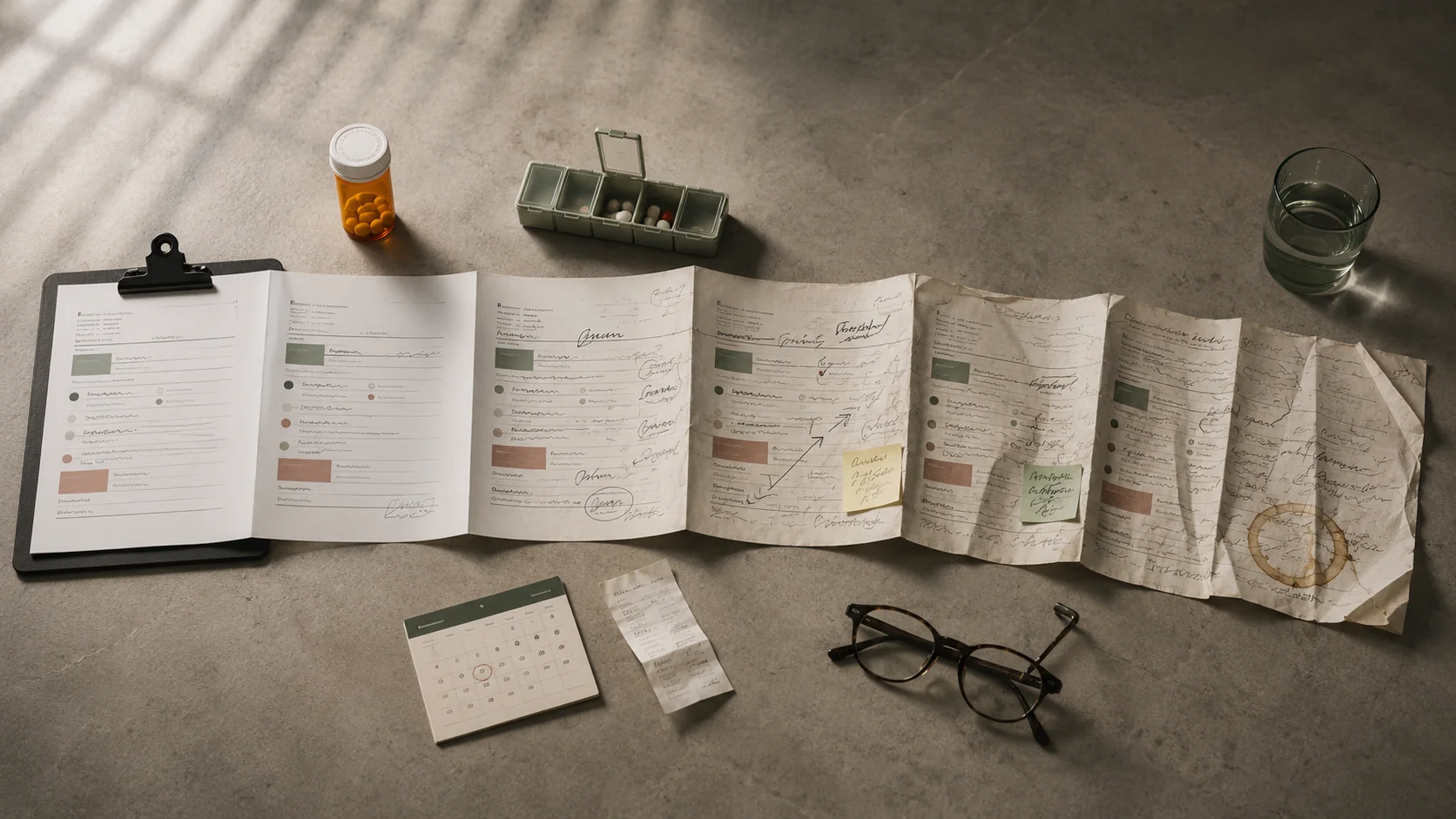
The prescription had not yet been collected. The patient’s usual bedroom was upstairs. The caregiver had assumed the hospital would supply dressings. Two versions of the medication list existed.5 No one had asked whether the patient could open the bathroom door while using a walking aid.
These were rarely failures of intelligence.
They were failures of imagination inside a system organized around departure.
A plan becomes more truthful when it is walked through in time.
The first tablet. The first meal. The first trip to the bathroom. The first question after office hours.
“A plan becomes more truthful when it is walked through in time.”
That small shift changed how I understood continuity after discharge. Continuity is not merely arranging a future appointment. It is preserving enough clarity and support that the patient does not fall into an avoidable gap before the appointment arrives.
Sometimes that requires equipment or professional home care. Sometimes it requires a phone call the next morning. Often it requires something less visible: agreement about who is watching, what change matters, and where uncertainty should go.[1,2]
The purpose is not to turn the home into a hospital.
Families should not have to reproduce a ward in the sitting room. The home should remain a place where a person can gradually stop being only a patient.
But that cannot happen if the household must first discover, alone and at night, which parts of the hospital were holding recovery together.
The night no one records
By morning, the first night may appear uneventful.
No ambulance was called. No wound opened. No crisis occurred.
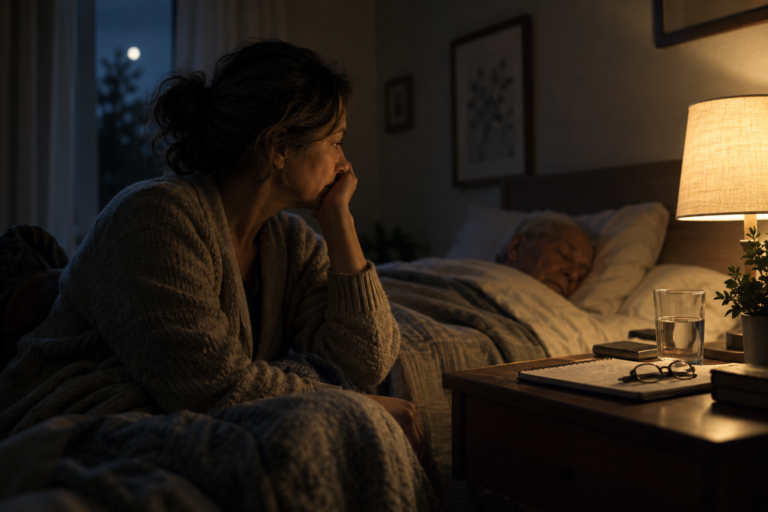
The patient slept in fragments. His wife may not have slept at all. She listened when his breathing changed, helped him stand, checked the medication sheet twice, and kept a lamp burning in the hallway.
None of this will appear in the operative report.
The hospital may record a successful discharge. The family will remember a different threshold: the first night they understood how much responsibility had followed them home.
That responsibility should not arrive as a surprise.
A safe transition does not require predicting every difficulty. No discharge plan can remove all uncertainty, and no family can be fully prepared for a body that is still changing.
But we can stop confusing the end of hospital need with the beginning of household readiness.
We can ask not only whether the patient is stable enough to leave, but whether the plan is small enough, clear enough, and supported enough to survive the place where recovery will actually occur.
Because the first night home is not a medical setting.
Discharge is not complete when the patient reaches home. It is complete when the plan can live there.
Sources and Further Reading
- Agency for Healthcare Research and Quality. Strategy 4: Care Transitions From Hospital to Home: IDEAL Discharge Planning. Guide to Patient and Family Engagement in Hospital Quality and Safety. AHRQ, Rockville, Maryland.
- van Grootel JWM, Collet RJ, van Dongen JM, et al. Experiences with hospital-to-home transitions: perspectives from patients, family members and healthcare professionals. A systematic review and meta-synthesis of qualitative studies. Disability and Rehabilitation. 2025;47(7):1644-1658. doi:10.1080/09638288.2024.2384624.
- Griffin JM, Holland DE, Vanderboom CE, et al. Assessing Family Caregiver Readiness for Hospital Discharge of Patients With Serious or Life-Limiting Illness Using Electronic Health Record and Self-Reported Data. Health Services Research. 2025;60(4):e14441. doi:10.1111/1475-6773.14441.
- Gonçalves-Bradley DC, Lannin NA, Clemson L, Cameron ID, Shepperd S. Discharge planning from hospital. Cochrane Database of Systematic Reviews. 2022;(2):CD000313. doi:10.1002/14651858.CD000313.pub6.
- Alqenae FA, Steinke D, Keers RN. Prevalence and Nature of Medication Errors and Medication-Related Harm Following Discharge from Hospital to Community Settings: A Systematic Review. Drug Safety. 2020;43:517-537. doi:10.1007/s40264-020-00918-3.
Author’s Note
The opening scene is a composite drawn from recurring clinical situations. It does not represent a single identifiable patient.